
What is Degrowth?
Nov 24, 2025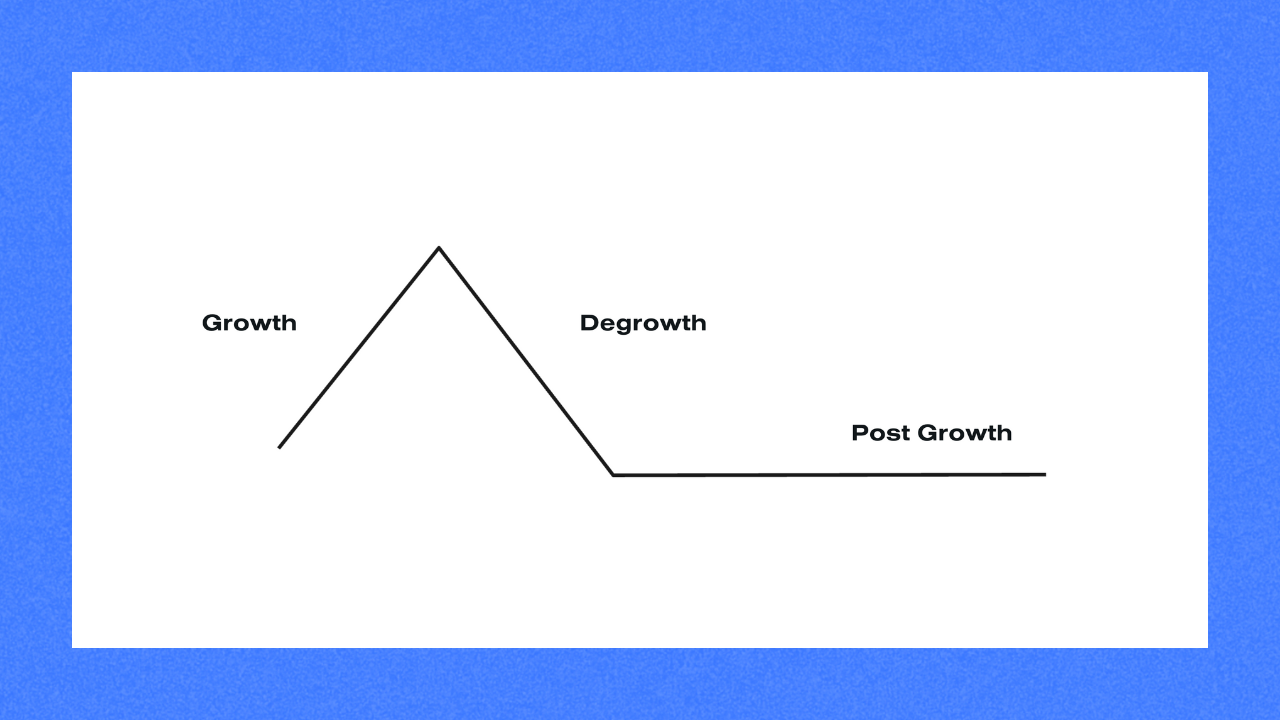
What is Degrowth?
We could also ask: What could Degrowth mean? To highlight that for us, this is not about finding the one definition to rule them all, but instead about describing a diverse field of different theories of change that, however, do agree on a few central things.
We could also ask: What is Post Growth? Those words are often used to describe the same thing. The term Wellbeing Economy is also circulating. Some say that Degrowth and a Wellbeing Economy cannot be united, but we disagree. We'll explain more later, but for now, we underline the main point: It is much more fruitful to take a pluralistic approach to the great predicament we are in. No one thing can address it all, so instead, look at how different approaches can contribute and figure out where you fit in best.
And with that, here comes the plain and simple 8-step breakdown.
1. The core argument of Degrowth
Degrowth proposes reducing the size of the global economy to pursue sustainability, justice, and equality.
The keyword is reduction. It's a critique of the blind pursuit of endless growth.
An underlying assumption is not to hope that increased levels of wellbeing come indirectly as a byproduct of growth, but to focus directly on increasing levels of wellbeing for all. It's a shift from indirect to direct policy proposals.
2. Why is a reduction of the global economy needed?
A reduction is needed because the mainstream (growth) strategy isn't working.
For the past 30 years, the strategy of governments and companies has bet on Green Growth (or tech-optimism) without delivering the needed reductions in footprint.
In short, the Green Growth/Tech-Optimism strategy promises that we can achieve absolute decoupling of emissions and resource use from economic growth.
There is no empirical evidence of sufficient, fast, and sustained decoupling anywhere in the world.
On top of that, it also promises to reduce inequality, and even that is not happening. Instead, inequality is rising. Both internally within countries and between The Global North (also called The Global Minority) and The Global South (also called The Global Majority).
If you are interested in learning more about how the Green Growth Strategy fails (and what to do instead), we have this short on-demand course: Understand The Green Growth Problem.
3. Why care about decoupling?
9 planetary boundaries exist, and we are transgressing 7 of them. For example, one such boundary is climate change.
If we don't cross the boundaries, we can continue to thrive in a 'safe operating space’ (we, in a broad sense meaning :The Global Minority).
When we cross a boundary, we increase the risk of tipping points: Large-scale and irreversible changes.
Anyone who has leaned back in a chair balancing on two legs knows there is a threshold beyond which you irrevocably crash to the floor. That threshold is a tipping point.
Two tipping point examples:
Ice melting: If temperatures rise enough to melt the ice sheets atop Greenland and West Antarctica, it could lift oceans more than a dozen meters.
Amazon: The Amazon tropical forest, upon which we depend to soak up carbon pollution, could turn into savannah.
What does that mean: More extreme weather events like flooding, longer and more severe periods of drought, less inhabitable land, less fertile land, and so the list goes on.
4. What grows and what doesn't.
The global economy has to shrink, but it is crucial to understand the nuances. Something has to grow, while something has to shrink.
Some sectors must grow: Plant-based and organic food production, renewable energy, repair, retrofitting houses, etc.
Other sectors must shrink: Conventional livestock food production, fossil fuels, fast fashion, etc.
Some countries (Global South) should be allowed to grow their economies when needed to raise living standards. And a note to that. We, as the authors of this text and our fellow citizens in the Global North, should not to force our growth-obsessed way of living onto others. That’s why we write, “should be allowed to grow (...) when needed.”, instead of “must”.
Other countries (Global North) must shrink their economies to free up ecological budgets so others may grow.
5. Justice: Leveling the playing field between the Global North
& Global South
There is an unequal exchange between The Global North and Global South, enforced via unfair trade agreements, debt, undemocratic global institutions, tax evasion, land grabs, military coups, and the list goes on.
To see justice, it’s not enough for Global North countries to shrink their economies to free up
ecological budgets, it is also necessary to dismantle the uneven neo-colonial structures via, for example, equal trade agreements, democratizing global institutions, debt cancellations, and reclaiming the commons.
6. Can we live good lives while consuming and producing less?
Quality of life is subjective, but there are real-life examples of people living good lives with less - and no, they don't live in caves.
Costa Rica, Bhutan, and many Greek islands are examples of a less-is-more lifestyle in societies with living standards similar to the average Global North country.
They own and consume less stuff, but they eat well, have roofs over their heads, can go to the hospital, get an education, and so forth.
We aren't saying they are perfect, and we aren’t saying they are the only examples, but they do paint a different picture.
7. What's the long definition of Degrowth?
A commonly used definition goes like this:
Degrowth is a democratically planned reduction of the global economy (energy and resource use) to achieve a just society within planetary boundaries that steers towards wellbeing, not money.
You can look at it this way:
Degrowth describes the transition, where Post Growth is the destination - a stable society without growth.
8. How do we avoid a catastrophic transition from capitalism to post growth?
It's the million-dollar question - with several suggestions on the table. First, it's essential to understand that recession and degrowth are not the same:
Degrowth is a planned and wanted process - we need new policies for this to happen.
A recession occurs when a capitalist economy stops growing - unplanned and unwanted.
At least five theories of change are circulating that align with what we have described in this text. We will list them here and briefly describe their core focuses. Outlining those in depth is worth a whole article in and of itself.
1. Democratically planned, centralized transformation
Universal basic services, basic income, ecological budgets, smaller market, larger civil society, larger welfare state.
2. Democratically planned, decentralized transformation
Much the same as group one, but instead, decision-making takes place in smaller units of commons, cities, and municipalities.
3. Decentralized market-driven transformation, with strict legislation
Ecological tax reform (ecological budgets), green job guarantee, pension-fund ban on exit investments, steward ownership of companies (not-for-profit business; if you are curious what these look like, we added a few cases of those kinds of companies in The Edge Playbook), shorter working hours, decolonization of the Global South, and maintaining the current market size.
4. Decentralized market-driven transformation, with minimal legislation
Organization in civil society, organization in the business sector, steward ownership of companies (not-for-profit business).
5. Collapse/emancipation, mitigate the fall of current structures and rebuild
Mentally preparing for something radically different, decentralized energy and food, local and informal community building, modular organization, resilience over efficiency.
As you can see, feeling that there is something off about the endless pursuit of economic growth and wanting to change that doesn't put you into one box. There are many ways we could go from here. We all have different roles to play, and if you have had the opportunity (and the stamina, because we tried to make it simple, but not short) to read this article, we hope you take the time to consider what you believe in and how you may best contribute to it.